 OpenAI Ads Manager·Early-Access Pilot
Marketing at the Moment of Intent.
OpenAI put an Ads Manager inside ChatGPT. 900 million weekly users, reached the second they ask for the answer.
This is not interruption marketing. It is shoulder to shoulder marketing. We just got into the beta, and we are piloting it for a small number of clients. Below is the full breakdown of how it works, why the psychology is the inverse of Meta, and how we are thinking about using it.
Interruption vs Intent
Every paid channel before this one interrupted attention. OpenAI Ads does the opposite. That single inversion changes the entire playbook.
- You interrupt someone who came to see their friends.
- You infer intent from likes, clicks, and lookalikes.
- You bid against every advertiser for a sliver of attention.
- The ad fights the content for the eyeball.
- Cold. The person was not thinking about your category.
- You appear when someone is actively asking for the answer.
- Intent is stated in plain language, in the prompt itself.
- You compete to be the most useful answer to a question.
- The ad sits shoulder to shoulder with the help they wanted.
- Warm. The person typed your category into the box.
Straight from OpenAIHow It Actually Works
The facts, from OpenAI’s own announcement. Ads began as a U.S. test for logged-in adults on the Free and Go tiers, and the rollout is expanding market by market.
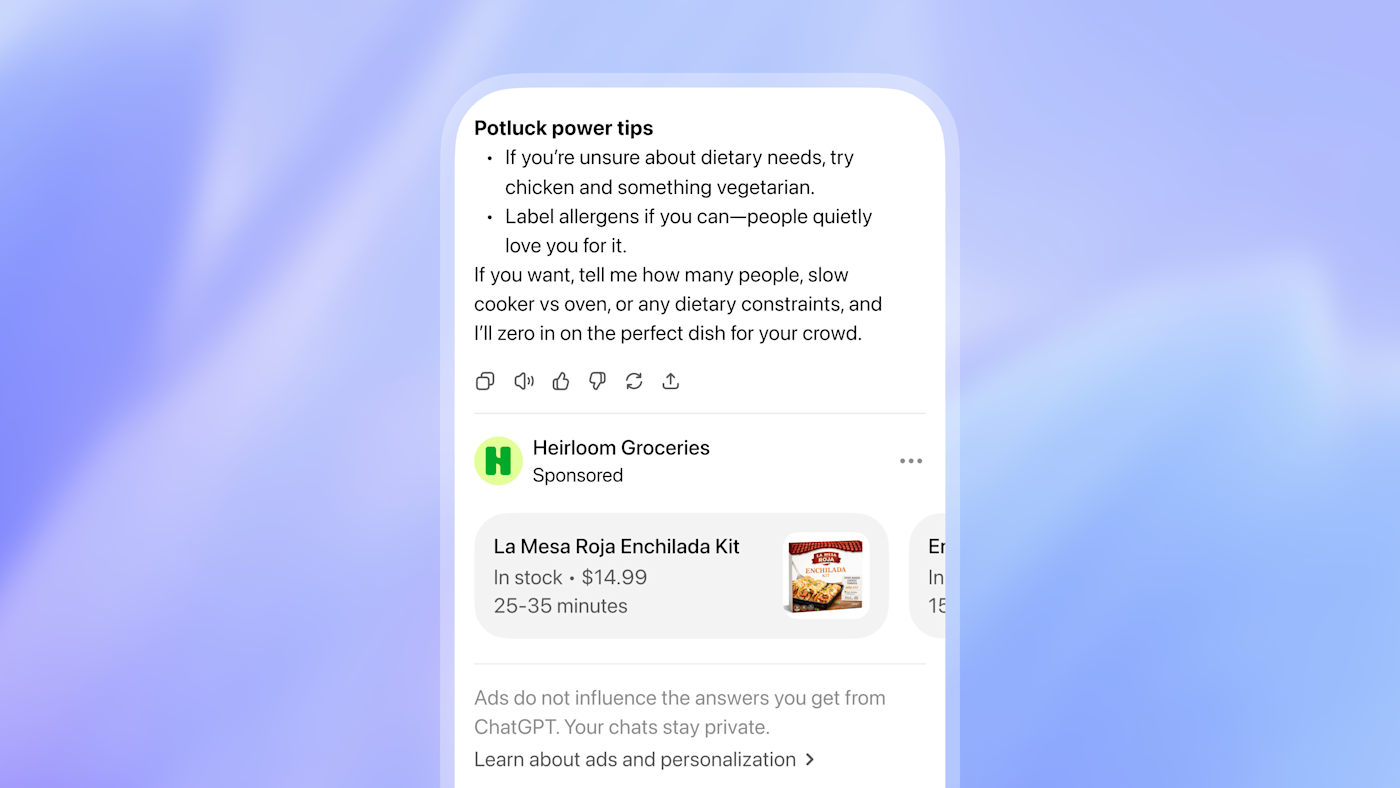
Logged-in adults on the Free and Go tiers. Plus, Pro, Business, Enterprise, and Education have no ads.
Clearly labeled sponsored and visually separated from the organic answer.
To your conversation topic, past chats, and past ad interactions. Most relevant advertiser shows first.
Only aggregate performance like views and clicks. Never your chats or personal details.
Not for under-18 users, and not near sensitive or regulated topics like health, mental health, or politics.
Started in the U.S., expanding to Canada, Australia, New Zealand, the UK, Mexico, Brazil, Japan, and South Korea.

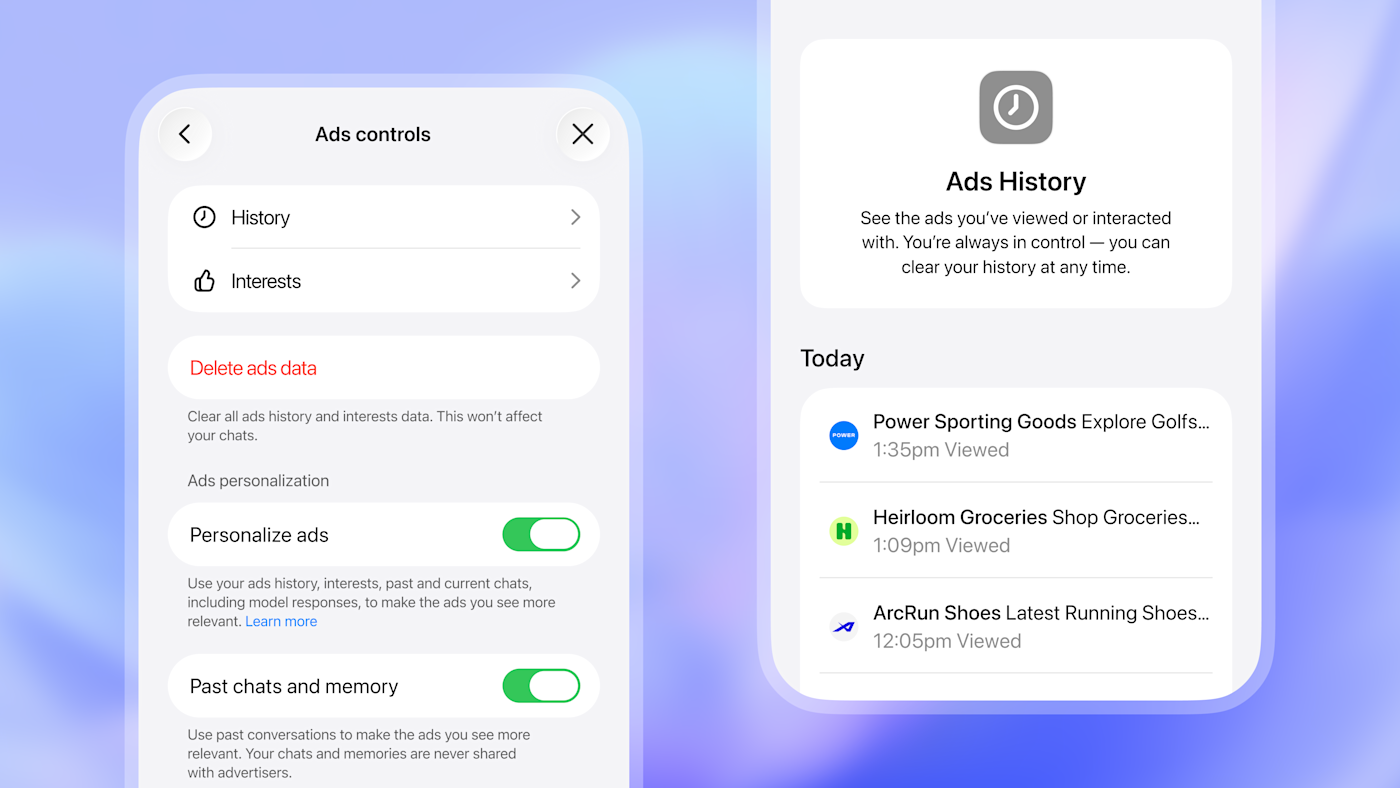 OpenAI’s stated principles
The Five Principles
OpenAI is not bolting ads onto a feed. The beta is governed by five stated principles, and they tell you exactly how this channel will be policed.
Mission Alignment
Ads fund fast, reliable free access. ChatGPT is used by hundreds of millions for learning, work, and everyday decisions, and ads on the Free and Go tiers help keep that broadly available. Prefer no ads? Upgrade to Plus or Pro, or opt out on Free for fewer daily messages.
Answer Independence
Ads do not influence the answers ChatGPT gives. Answers are optimized for what is most helpful to you, and ads are always clearly labeled sponsored and visually separated from the organic answer. This is the principle that changes everything.
Conversation Privacy
Advertisers never see your chats, history, memories, or personal details. They receive only aggregate performance like views and clicks. No ads for users under 18, and none near sensitive topics like health, mental health, or politics.
Choice and Control
You can dismiss ads, share feedback, see how and why an ad was shown, delete your ad data with one tap, and manage ad personalization at any time.
Long-Term Value
People use ChatGPT while exploring options, comparing ideas, and working toward a decision. In those moments ads can surface relevant products and services, with a clear separation between ads and answers always maintained.
Why this matters: answer independence means you cannot buy a better answer. The only way to win is to genuinely be the best response to a real question. That rewards substance over spend, which is exactly the game a premium top of funnel partner wants to play.
How the Ads Manager Works
If you have ever run Meta or Google Ads, the skeleton is familiar: campaigns, ad groups, ads. What changes is what each layer is really targeting.
The catch that everyone will miss: OpenAI is deliberately ramping delivery during the beta. Spend is not the lever it is on Meta. You are not buying impressions, you are earning the right to be the answer. The advertisers who treat their ad like a genuinely useful response, not a banner, are the ones the system will favor.
This Is the 2009 Moment
Early Facebook ads minted fortunes for the people who learned the mechanics before they got expensive and crowded. The same window is open here, and it is wider, because the intent is real.
The advertiser program is just opening, so the cost of learning the platform is about as low as it will ever be.
Far fewer advertisers than a mature ad auction, so there is real room to stand out while it is still early.
The playbook you build now is the one everyone else pays to copy in 2028. Early reps compound.
How We Are Piloting It for Clients
We are inside the beta running real campaigns and feeding feedback to OpenAI. Here is the loop we run for a pilot client.
Map your real intent surface
ResearchWe start from the questions your buyers actually type into ChatGPT, not keywords. What problem are they describing the moment before they would need you? That question list becomes the campaign.
Build the answer, not just the ad
CreativeOn an intent platform the winning creative is the most genuinely useful answer. We craft offers and landing experiences that read as the helpful next step, not an interruption.
Wire it into your funnel
PlumbingClicks flow into the same enriched, scored, routed pipeline we build for every client. n8n captures the lead, OpenClaw qualifies it, and your CRM and Slack light up in real time.
Feed the loop
LearnWe are inside the beta giving OpenAI direct feedback, and we read delivery as it ramps. Every campaign sharpens the next while the cost of learning is still near zero.
OpenAI Ads for B2B: The Top of Funnel Playbook
The full breakdown in one PDF: how the Ads Manager is structured, the intent-first creative framework, how to wire clicks into a real funnel, and the pilot checklist we use. Drop your email and it is yours.
Want to be early on this?
We are taking on a small number of OpenAI Ads pilots. We will tell you honestly whether your business is a fit for an intent channel right now, or whether to wait. Either way you walk away knowing how to play it.